
September is the quiet before the Q4 storm, or is it time to lock in? Consumers are getting back into family and domestic routines after summer holidays in the Northern Hemisphere, and the smartest app marketers are already bidding on this paramount seasonal moment. What happens this month has a direct impact on the budgets, creative, and measurement strategies that will decide whether Q4 is a breakout quarter or a scramble. Those vying for Black Friday install spikes or New Year’s resolution downloads know that it’s too late to test the campaigns that win in November. You’ve got to build–and capitalize–in September.
As far as the calendars go, the 22nd marks the official end of summer, with the Autumn equinox falling on September 23 (1:05am GMT). However, regardless of where you find yourself laterally or longitudinally, as an app marketer, the back-to-school moment is the real marker of the change of seasons, and what’s to come for the busiest time of the marketing year. That’s right, back-to-school is now a season, and a cross-device one at that.
In 2026, that prep for months ahead looks different. Privacy-driven measurement shifts, AI-generated creative at scale, and tightening CPIs across nearly every vertical mean the old ways of the marketing warrior of “just increase spend in Q4” won’t cut it.
Whether you’re scaling the next great hyper casual puzzle app, an Ecommerce shopping app bracing for holiday traffic, or a fintech app riding year-end budgeting behavior, the fundamentals are the same but the consumer habits at play, measureability levers, and the cross-device opportunities paint a different picture.
The Calendar Isn’t Global: Your Media Plan Shouldn’t Be Either
“Back-to-school” reads like a single event on a UA dashboard, but the underlying calendar is a potpourri of dates across geographies. US and Canadian districts (in general) started back through late August, while the UK and much of Western Europe cluster around the first week of September.
In India for instance, academic terms are already underway well before Diwali arrives later in the autumn season, meaning South Asian audiences experience “back-to-school” and the festive gifting season as two overlapping, not sequential moments. That overlap matters for creative output; a campaign that treats Diwali (a major UA and re-engagement moment across South Asia and its diaspora) purely as a Q4 holiday push risks missing the household still finishing supply lists in parallel. Family habits compound the complexity, as dual-income households increasingly delegate shopping decisions to responsible teenagers or caretakers via shared payment apps. Expect parents of younger children to remain the gatekeepers, thus directly shaping whether creative speaks to the buyer or the end user.
University vs. K-12: Two Funnels, Two Economics
Collegiate audiences behave like a distinct vertical altogether and are very important to analyze for cultural and city–landscape nuances; what works in Toronto won’t match the lexicon of Tampa. Tap into granular geo-specific retargeting areas to take advantage of those distinctions.
In this university-bound segment, expect higher average order values, longer consideration windows, and a heavier reliance on marketplace, resale, and subscription apps (furniture for 1 year leases, textbook rentals, meal-plan management, budgeting tools). “Back-to-college” spending is forecast to hit a record US $103.5 billion this year, surpassing $100B for the first time. UA campaigns should isolate this cohort with its own creative and bidding strategy rather than folding it into general “back-to-school” K-12 targeting.
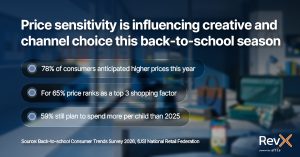
By contrast, elementary and secondary audiences are timely and routine-driven, and rely heavily on financial influence and approvals from elders. Sneaker drops and athleisure relevant to the scholastic year, thrifted or resale apparel apps, might capture share from traditional retail outlets propelled by sustainability messaging that resonates with Gen Alpha parents. Expect fashion-forward creative to outperform pure utility messaging this year. If you’re starting your campaign messaging in early-mid September, you’re not too late, since many consumers are delaying purchasing to manage budgets.
Subscriptions, Homework, and the AI Layer
AI-powered tutoring, essay assistance, and flashcard apps see a predictable spike in trial starts as syllabi are passed out around classrooms this time of year. The homework-help and study-app category is one of the most competitive subscription verticals of the season. However, the real KPI battle for these apps is free-to-paid conversion once the initial homework crunch hits in mid-to-late September.
Parental control and screen-time management apps follow a similar occurrence, as routines reset and families renegotiate device rules. Pair this with transportation and scheduling apps such as, carpool coordination, school-bus tracking, shared family calendars, and you get a cluster of utility categories where install intent is compressed into a 2-3 week window, rewarding marketers who pre-build creative rather than react in real time.
Building the Cross-Device Back-to-School Stack
For UA and retargeting leads, this is a multi-surface opportunity. Mobile remains the acquisition workhorse, but Connected TV inventory becomes more valuable as collegiate and professional sports events, including the tail-end of the US Open, college football, the NFL (National Football League), UEFA (the Union of European Football Associations) fixtures, pull families back to viewing environs, creating premium co-viewing moments for household-oriented offers.
In-app video game inventory sees an evening usage bump as family units settle into new routines, making rewarded video and playable ads a strong complement to social. On channels such as TikTok and Instagram “back-to-school haul” and other UGC video content continues to outperform static product ads, and should be fed directly into retargeting pools rather than treated as a top-of-funnel afterthought.
The Calendar is Just Getting Started
Before you get tripped up on the app marketing hopscotch of treating Labor Day (September 7 in the United States and Canada), or other mid-September school start-dates as a finish line, consider this window a moment for important measurement, and as a brand litmus test.
In reality, back-to-school is the catalyst to bigger, momentous moments ahead. The school year offers a plethora of activation opportunities and a calendar structure that dictate family, relational, community, and professional dynamics year round.
KPI planning should explicitly bridge into holy days, fashion and Halloween-driven seasonal app and commerce spikes, and the on-ramp into 11.11, Black Friday, and December holidays. Retargeting audiences built during back-to-school, being that they are often diverse, intergenerational and loyal to their communal ties, are exactly the pools that should be nurtured, not discarded, as the calendar rolls into this next wave of high-intent shopping, gathering, learning, and entertainment moments.
Here’s what should be on your radar this month.
- Lock in creative testing before Q4 costs spike. CPMs climb fast once holiday budgets flood in. September is your window to test hooks, formats, and angles more economically so you know what to scale in November.
- Plan creative refresh cadence that goes beyond volume. AI-generated creative makes it tempting to flood ad accounts with variants, but fatigue hits faster than ever. Build a refresh calendar tied to performance decay, not a one-time production sprint.
- Segment your Q4 moments by vertical. “Holiday season” means different things depending on your app and your region of interest. E.g. shopping apps ramp around Black Friday/Cyber Monday, fitness and productivity apps see a second wave around New Year’s, and finance apps often see year-end tax and budgeting spikes. Map your specific moments now.
- Audit your measurement stack for post-privacy reality. SKAN and probabilistic modeling aren’t new, but many teams still have gaps between what they can measure and what they’re optimizing toward. Fix attribution blind spots before Q4 buys makes bad data expensive.
- Revisit your LTV assumptions. Rising acquisition costs only make sense if your LTV models are current. Pressure-test cohort data from earlier this year before committing Q4 budget to channels that looked good in Q2.
- Diversify beyond your top channels. Everyone piles into the same networks in November through December, further driving up costs. Testing a secondary or emerging channel now gives you leverage when the bigger players get crowded. E.g. RevX can help your app run retargeting on Connected TV (CTV), and zero in on customer acquisition costs on SANs (Meta, TikTok, Snap, Google).
- Build your incrementality testing plan. Holdout tests take time to run cleanly. If you want real answers about what’s driving Q4 lift, the test needs to start before the real noise does.
In conclusion
For app marketers, this window is a compressed, high-stakes opportunity that starts fast, hardly before your users have wiped off their sunblock from the vacation season and queued up for their first pumpkin spice latte, but it’s not to be ignored for shinier things during Q4.
The core play: capture demand early, reallocating retargeting budgets into electronics, apparel, and dorm/study categories as summer travel installs plateau, while segmenting creative sharply between K-12 (fashion-driven, parent-gatekept) and university (higher AOV, subscription-and-marketplace-driven) audiences rather than treating “back-to-school” as one funnel or dumping into a single channel.
Most importantly, don’t let retargeting pools go cold once September ends; the same parents, caretakers, students, and gift-buyers you acquire now are exactly who you’ll need to re-engage as the festive season, seasonal 9.9 and 11.11 mega sales, Halloween, and Black Friday/Cyber Monday roll in back-to-back.
Marketers who build a connected media plan spanning through the holiday runway, rather than disconnected campaigns, will be poised to capture a disproportionate share of a season that no longer has a clean finish line.
Ready for a clear, actionable framework to guide your back-to-school campaign strategy and start planning with confidence? Talk to a RevXpert about building in-app, mWeb, Intellibid (social) and Connected TV strategies for this crucial period. Get in touch with our Team of app marketing experts here.

Lauren Heineck